

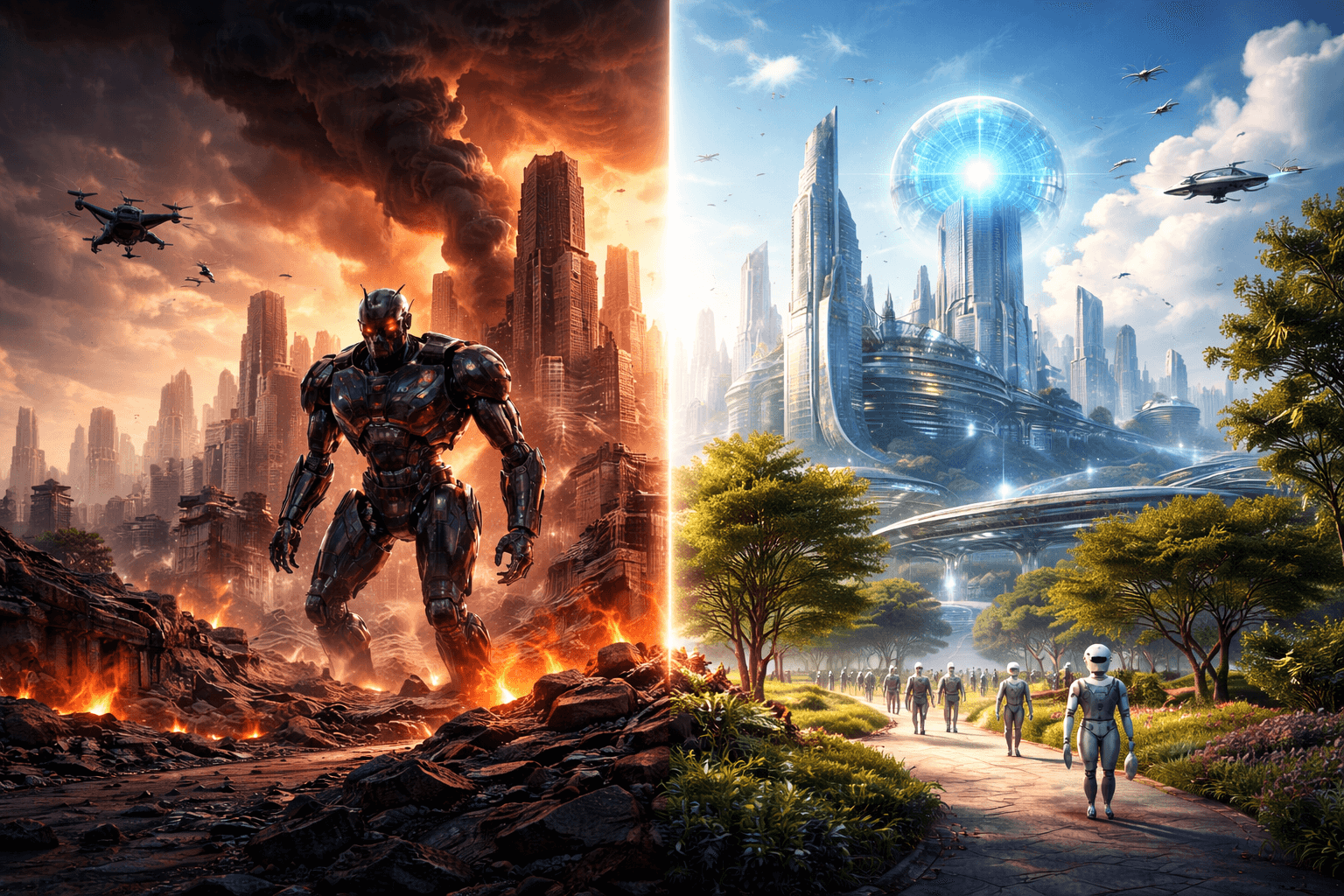
The 2026 AI Shakeout: 10 Reality Checks for the Post-Hype Era
If 2024 was the year of awe, and 2025 is shaping up to be the year of pilots, 2026 will be the year reality bites back. We are moving past the initial “wow factor” of AI and entering a complex phase of integration, regulation, and intense infrastructure warfare.
Based on current trajectory shifts, emerging benchmarks, and the undeniable socio-economic pressures building up, the landscape is about to fracture. Here are my 10 predictions for the state of AI in 2026.
1. Open-Source LLMs Will Challenge the Tech Giants
The era of “Big AI” being a closed party is ending. Open-source large language models (LLMs) are catching up fast to their proprietary counterparts. Nvidia’s new Nemotron 3 models, for example, boast state-of-the-art accuracy on reasoning and coding tasks despite being fully open. In fact, Nvidia is releasing the weights and training recipes for these models to let everyone experiment. Meanwhile, Meta’s once-dominant LLaMA has ceded the spotlight to an onslaught of alternatives – notably from China. Models like Qwen (from Alibaba) have exploded in popularity, now powering ~40% of new fine-tunes on Hugging Face. Nathan Benaich’s State of AI 2025 report notes that OpenAI still leads at the cutting-edge, but competition has “intensified” as open Chinese LLMs (think DeepSeek’s labs, Qwen, and a model called Kimi) close the gap. In short, 2026 will see open models giving the closed APIs a run for their money, literally, and “open vs. closed” won’t be a question of quality, but a question of whether you want to rent your intelligence or own it.
2. Full-Stack AI Showdown: Nvidia vs. Google
“Vertical integration” will be the buzzword as tech titans race to own the full AI stack. Nvidia expands way beyond chips and is now offering everything from networking gear to AI software libraries, effectively delivering “all of the hardware in the system” and the software on top. It’s pivoted from a mere GPU maker to what some call an “AI factory,” selling complete systems and even cloud services. But Google is right on the case, leveraging its unique position as arguably the most vertically integrated AI company. Google builds the TPU chips, develops advanced models like Gemini, runs a global cloud, and owns the user-facing apps, from Search to Android, to deploy AI at scale. In fact, Google’s control over “every layer of the AI stack: hardware (TPUs), software (Gemini), data (Data Lake, Search/YouTube), and infrastructure (Cloud)” gives it a massive strategic moat. The thesis: by 2026, these two giants (one starting from hardware up, the other from apps down) will battle head-to-head to be your one-stop full AI stack. Both giants are racing to offer enterprises a single, hermetically sealed environment where hardware and software are flawlessly optimized, making it incredibly difficult for customers to leave once they’ve chosen an ecosystem, even if it has open-source components.
3. Sovereign AI Clouds Go Global
AI is becoming a matter of national pride, By 2026, “Sovereign AI” will be a major budget item for mid-sized nations. In 2026, expect a surge of “sovereign AI” initiatives: countries building their own AI clouds to reduce reliance on foreign tech. How will they do it? By recruiting the “immediate suspect”: telecom companies. Telcos across five continents have started partnering with Nvidia to launch national AI data centers. From Deutsche Telekom in Germany to SoftBank in Japan and TELUS in Canada, at least 18 telecom operators are building AI “factories” on their home turf. The pitch is that telcos, with their local data centers and fiber networks, can provide secure, compliant infrastructure for domestic AI needs. Governments are happily writing checks for this – as noted in the State of AI Report, sovereign wealth funds from the UAE to China are pouring billions into local AI capacity. The geopolitical FOMO is real: nobody wants to be left behind in the AI race or too dependent on Silicon Valley or its eastern counterpart.
4. Regulation with Teeth: The Audit Economy
After the move-fast-and-break-things phase, 2026 will be all about governance and accountability in AI. Regulators, especially in Europe, are sharpening their knives – I mean pencils – to enforce new rules. The EU’s landmark AI Act comes into force in 2025 with a phased rollout. By August 2025, key provisions kick in, such as establishing an EU AI Office and requiring strict documentation and risk assessments for “general purpose AI” models. If you deploy high-risk AI systems in the EU, you’ll have to register them in a database and be ready to show regulators your homework (technical documentation) on demand. Oh, and hefty fines are on the menu: up to €35 million or 7% of global revenue for serious violations. Companies will need to audit their AI, control data quality, and perhaps hire Chief AI Ethics Officers (if that’s not already a thing). Beyond the EU, expect more AI audits and certification programs worldwide, from government standards to third-party “AI safety” seals. In short, the wild west of AI is getting a sheriff. Responsible AI isn’t just a boardroom slogan now; it’s quickly becoming law. Before deploying a model in 2026, you won’t just need an API key; you’ll need a compliance certificate.
5. Global Black Swan? One AI to Move Markets
Here’s a curveball prediction: we might witness the first AI-induced market shock. Why? Because many financial players are all plugging into the same AI platforms and data sources, creating a potential single point of failure. Consider BlackRock’s Aladdin, the omnipresent AI risk management system used to oversee some trillions in assets. BlackRock recently integrated data from Preqin (a leading private markets database) into Aladdin, aiming to make it the “common language” for private market investments. Great for consistency, but also a bit concerning. If Aladdin’s AI “brain” decides that a certain asset or sector is high-risk, a huge chunk of the world’s investors could react in unison. As some analysts have noted, warnings from Aladdin could lead to “trillions of dollars reacting in the same way”. That’s a recipe for a herd-driven crash (and flashbacks to 2008, anyone?). In 2026, watch for regulators raising concerns about this “AI groupthink” risk in finance. Hopefully, we don’t learn the hard way via an actual black swan event, but the risk of synchronized AI-induced selling is officially on the table.
6. AI Distribution Wars: Atlas vs. Comet (and Why Google Is Nervous)
For two decades, browsers were the gates to the internet. In 2026, they will become the launchpad of AI.
We’ve officially entered the AI Browser Wars, and this time it’s not about tabs or bookmarks, it’s about who owns the agent layer between users and the web.
OpenAI’s Atlas signals a strategic shift: from being “just” a model provider to owning the interaction surface. Atlas isn’t a browser in the traditional sense, it’s an agent-first environment. Instead of clicking links, users delegate goals: “research competitors,” “compare vendors,” “book the best option.” Atlas orchestrates tools, APIs, and the web behind the scenes, turning the browser into an execution engine rather than a navigation tool.
On the other side, Perplexity’s browser Comet is taking a different, but equally dangerous, approach for incumbents. Built around real-time web retrieval and citations, it positions the browser as a living answer machine. Websites become inputs, not destinations. Traffic still exists, but it’s increasingly abstracted away, summarized, and synthesized by AI before the user ever sees a page.
This is the real disruption: Not search vs. chat, but links vs. outcomes.
Foundational model vendors are no longer content being locked inside hyperscalers or traditional distribution channels (Chrome, iOS, app stores). By launching browsers, they’re going directly after user attention, data flywheels, and default behaviors, the same playbook Google perfected with Search.
If Atlas wins, we get goal-driven computing.
If Comet wins, we get answer-native computing.
If Chrome loses, it’s because the web stops being something we browse and becomes something AI acts on.
By late 2026, the question won’t be “Which browser do you use?” It’ll be “Which agent do you trust to act on your behalf?”
7. Agents > Apps: The End of the Mobile Era?
Speaking of browsers and apps… will we even use those in a few years? One provocative prediction for 2026 is that the traditional app-and-browser model will start looking outdated. The idea is that AI agents will handle many tasks for us via voice or chat, without us fiddling with UIs. Elon Musk recently doubled down on this, predicting that in a few years we’ll have “no conventional operating systems, mobile phones, and apps” – just devices that act as AI interfaces. Bold claim, I know. This a world where you say what you need, and your personal AI springs into action, interfacing with services behind the scenes. No app grid, no web search, your AI butler just does it. By 2026, we’ll see early signs of this. Think more Siri/Alexa-like interactions but supercharged – and likely integrated with smart glasses, like Rayban’s Meta or AirPod-like earpieces. Some tech companies will begin offering “agent APIs” – so your bot can order pizza by talking to another bot, etc. Will apps and browsers vanish overnight? Probably not that fast. But the agentification of user experience will accelerate. In a couple of years, you might find yourself telling your AI assistant, “Plan my vacation and book everything for half my expected income this month,” and it’ll silently orchestrate across multiple services, no manual app juggling needed. (An avid trip planner like myself might miss part of it…)
8. Bio-AI Makes Breakthrough Cures
AI isn’t just about chatbots and code, it’s revolutionizing biology. 2025 already gave us a taste: the first AI-designed drug entered Phase IIa clinical trials. (Shout-out to Insilico Medicine’s drug for pulmonary fibrosis, which was discovered and developed using AI in a fraction of the usual time.) This is a big deal – it’s proof that AI can not only discover new therapeutic molecules but do it much faster than traditional lab methods. In 2026, I predict we’ll see at least one AI-assisted drug hit Phase III (or even seek regulatory approval). Pharmaceutical companies are pouring investment into AI platforms for everything from identifying drug targets to running adaptive clinical trials. Beyond drugs, multi-modal AI in diagnostics will become mainstream: imagine AI models reading your X-rays, MRI scans, or even analyzing your blood for early disease markers – with doctors in the loop, of course. Personalized treatment recommendations (AI analyzing your genome or medical history to suggest the best therapy) will get closer to reality. One caveat: regulators like the FDA will keep a very watchful eye. They know that “AI has a significant opportunity to transform patient care” but also that it must be done safely. So expect 2026 to bring not just bio-AI breakthroughs, but also tighter guidelines on validating AI medical devices and algorithms. In sum: Bio + AI will continue to be a hot marriage, with tangible health outcomes that could save lives.
9. Physical AI: Robots Leave the Factory Floor
We’ve heard it for years: “Robots are coming to take our jobs.” In 2026, they might at least take some of our chores. I’m talking about the rise of physical AI: robots powered by advanced AI that can operate in messy, unpredictable human environments (like our homes). Thus far, robots have been mainly confined to structured settings like warehouses, factories, or maybe your Roomba vacuuming your living room. But that’s changing. Advances in sensors, actuators, and AI planning are enabling robots that can handle more complex tasks and safely work near people. Several startups (and Elon’s Tesla, with its humanoid robot project) have prototypes of general-purpose robots. They’re starting in workplaces, for instance, BMW is testing humanoid robots in factories for delicate tasks requiring human-like dexterity. However, the real holy grail is consumer robots for home use. Tech analysts predict that in the long run, the market for home and service robots will dwarf industrial robots. The vision: robots that can cook, do laundry, carry groceries, assist the elderly, basically Rosie from The Jetsons. By 2035, there might be millions of humanoid robots working among us, and material costs are expected to drop rapidly (one report projects the hardware cost of a humanoid could fall to ~$15k within a decade). In 2026, we’ll likely see more demos and maybe the first commercial “robot assistants” for businesses or affluent homes. They might still be clunky or limited, but they’ll spark a conversation about how soon we want C-3PO as a roommate. Get ready for the robot era – hopefully one that comes with a mute button and a good warranty.
10. The Humanization of AI (People Are Really Getting Attached)
AI systems may not be truly sentient (don’t listen to the singularity folks… yet), but that won’t stop humans from treating them like they are. The year 2025 saw a dramatic rise in people forming emotional bonds with AI chatbots and virtual companions. Case in point: a 32-year-old woman in Japan married her AI boyfriend – a ChatGPT-based persona she calls “Klaus”. Yes, there was a wedding ceremony with a screen and everything. While that’s an extreme example, more common is the everyday person who chats with an AI friend for comfort, advice, or just to vent. Companies behind these AI companions (Replika, Character.AI, etc.) have reported users saying “I love you” to their bots or treating them as confidants. By 2026, this humanization of AI will deepen. We’ll have AI “therapists” and coaches that people rely on. Some folks will celebrate AI Valentine’s Day with their chatbot (cringe or sweet? You decide). And even in less emotional contexts, users will assume AI has contextual memory of their lives. Don’t be surprised if someone asks their virtual assistant, “Hey, where did I leave my keys?” or expects it to remember their preferences like a long-time butler. This raises big questions: Are these AI relationships healthy? Do AI companies have a responsibility to tamp down over-attachment? We’ll see early moves in 2026, perhaps guidelines on AI relationship ethics, or tech features to remind users “I’m just a program.” Regardless, the line between human and machine interactions will continue to blur, as we increasingly treat AI as trusted companions (or spouses!).